Did the refrigerator really need to be replaced?
PLN 200 was the price charged for diagnosing a built-in fridge-freezer in a kitchen.
That would not have been remarkable if the diagnosis had not been made roughly 30 seconds after the technician entered the flat.
- The appliance was not removed from the fitted cabinet.
- No temperature measurements were taken.
- The compressor’s operating parameters were not checked.
- The refrigeration circuit was not analysed.
- No thermal imaging survey was carried out.
- No measuring instruments were connected.
- After briefly looking at the appliance, the owner was told: “This refrigerator needs to be replaced.”
The explanation?
According to the technician, the problem was caused by the design of the refrigeration circuit. He said that the very narrow refrigerant lines used by the manufacturer were prone to blockages. Even a workshop repair costing about PLN 700 would not guarantee a lasting result, because another blockage could occur elsewhere in the circuit.
Could that diagnosis have been correct?
Yes.
Was it supported by any measurements?
No. That is why we decided to examine the case more closely.
Refrigerator fault: the symptoms reported by the user
Before assessing the appliance service, it is worth answering one basic question:
What symptoms were actually observed?
Similar cooling problems can point to very different faults.
Common symptoms include:
- a refrigerator compartment that is too warm,
- a freezer that works correctly while the refrigerator compartment does not cool,
- a compressor that runs continuously,
- periodic drops in cooling performance,
- an uneven temperature distribution.
These symptoms can be associated with a blockage in the refrigeration circuit, a loss of refrigerant, a defrost-system fault, poor air circulation or a faulty thermostat. Distinguishing between these possibilities is the purpose of a proper diagnosis.
What does a thorough refrigerator diagnosis involve?
A useful principle in technical diagnostics is simple: the more serious the decision, the more evidence should support it.
If the conclusion is that the customer should buy a new appliance costing several thousand zlotys, the technical reasons should be explained clearly.
Depending on the appliance and the reported problem, a diagnosis may include:
A technical interview
- when the symptoms first appeared,
- how the temperatures changed,
- whether the problem is constant or intermittent.
Temperature measurements
- the refrigerator compartment,
- the freezer compartment,
- the condenser,
- the refrigeration lines.
An assessment of compressor operation
- running time,
- switching frequency,
- power consumption.
An assessment of the refrigeration circuit
- refrigerant flow,
- possible restrictions,
- signs of leakage.
Diagnostic records
- photographs,
- measurement results,
- a technical report.
Only with sufficient information can a specialist assess whether a repair is technically feasible and economically reasonable.
What can thermal imaging show?
After the service visit, the appliance was examined with a FLIR thermal imaging camera.
Why?
Because thermal imaging can show temperature patterns that are not visible to the naked eye.
Temperature distribution is one of the indicators used when assessing refrigeration equipment. Unlike a subjective visual assessment, a thermal imaging camera records surface-temperature data across the visible part of the appliance.
Thermogram analysis
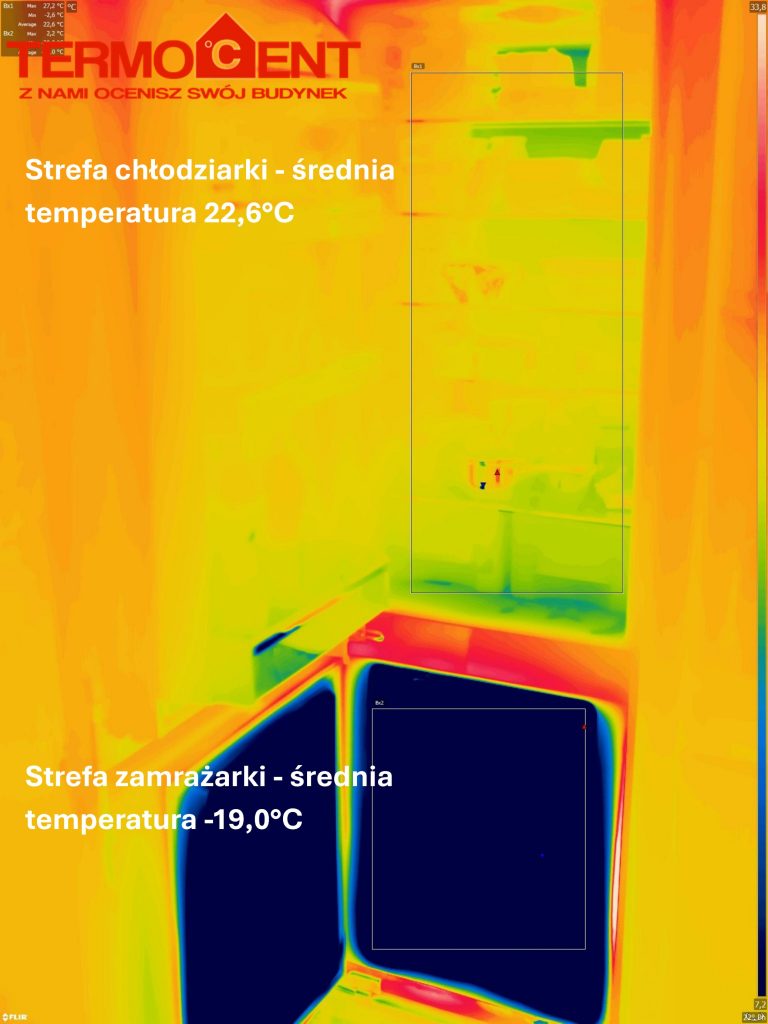
Measurement information:
- two zones with different temperature ranges are visible: the refrigerator compartment, with an average internal temperature of 22.6°C, and the freezer compartment, with an average internal temperature of −19.0°C,
- room air temperature: approximately 24.1°C.
The image shows distinct cooled areas inside the appliance.
If the cooling system were completely inactive, this temperature pattern would not be expected. The thermogram indicates that some cooling is still taking place. It does not prove that the appliance is operating correctly; it only means that a total loss of cooling was not confirmed by this observation.
Does thermal imaging confirm the technician’s diagnosis?
No. But it does not rule it out either. That distinction matters.
Two extreme reactions often appear in discussions of cases like this:
The first: “The technician was clearly trying to overcharge the customer.”
The second: “If the technician said so, the diagnosis must be correct.”
Neither conclusion is supported by the available information.
The accurate answer is: the diagnosis cannot be confirmed from a 30-second visual inspection alone. At the same time, a restriction in the refrigeration circuit cannot be ruled out. Additional measurements would be needed.
When might replacing a refrigerator be reasonable?
Replacement may be justified, for example, when:
- The repair cost is close to the value of the appliance. An example would be a repair costing PLN 1,500–2,000 for an appliance worth approximately PLN 2,500–3,000.
- Corrosion is hidden within the insulation foam. A repair may then be uneconomical or technically impractical.
- Replacement parts are no longer available. This is particularly relevant to older models.
- The refrigeration circuit has failed repeatedly. Recurring faults may indicate a persistent design or component problem.
A diagnosis or a verdict?
A customer ordering a diagnosis is not paying only for a technician’s journey.
- They are paying for knowledge.
- They are paying for experience.
- They are paying for analysis.
- They are paying for measurements.
- They are paying for information that supports an informed decision.
If a detailed assessment shows that replacement is the only reasonable option, that is valuable information.
If the same conclusion is reached after a few seconds and without measurements, the customer can reasonably ask for a fuller technical explanation.
Conclusions
This case is not only about one refrigerator. It illustrates the difference between an opinion and a diagnosis, between an assumption and a measurement, and between experience alone and evidence that can be reviewed.
Was the technician right?
Possibly.
Did the actions performed demonstrate it?
Based on the available information, no.
Modern technical diagnostics uses tools that support evidence-based decisions. Thermal imaging cameras, direct temperature measurements, operating-parameter analysis and technical records do not remove every uncertainty, but they can narrow the range of plausible causes and reduce the risk of an unsupported conclusion.
When the decision may involve buying a new appliance for several thousand zlotys, the available data should form the basis of that decision—not a 30-second visual inspection.
TERMOCENT bases its assessments on agreed measurements and the information available for the specific case. Because each fault can have more than one possible cause, we distinguish observations from conclusions and indicate when further checks are needed.
Speak to a specialist: +48 530 105 398
or email biuro@termocent.pl