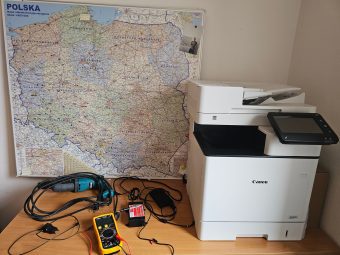
An electrical appliance can appear to work correctly without providing enough information to determine whether it remains safe to use. A power tool may start, its motor may run and the appliance may perform its intended function, but this says little about the condition of its protective conductor, insulation or leakage current.
For this reason, an electrical equipment safety assessment should not be limited to checking whether the appliance works. It requires a visual inspection, appropriately selected measurements and a competent interpretation of the results.
TERMOCENT tests the electrical safety of power tools, electrical appliances and welding equipment. The scope of each inspection is selected according to the equipment design, its intended use and the purpose of the test.
What does electrical equipment safety testing involve?
There is no single universal measurement that can assess every type of appliance.
A Class I power tool may require a different procedure from a double-insulated appliance, an extension lead, a three-phase device or welding equipment. Testing therefore begins with identifying the appliance and selecting the applicable procedure.
Depending on the equipment, the inspection may include a visual examination, checking the continuity and resistance of the protective conductor, measuring insulation resistance and leakage current, carrying out a functional test, inspecting leads and, where applicable, testing RCD or PRCD protective devices. Welding equipment requires additional measurements specific to the welding circuit and power source.

The objective is not to perform the greatest possible number of measurements. It is to choose tests that match the construction and intended use of the particular item of equipment.
Why is switching the appliance on not enough?
Consider a drill, grinder or another power tool used every day.
It can be connected to the mains, switched on and found to perform normally. This does not confirm that all parts of its protection against electric shock are in the required condition.
A fault in the protective conductor or insulation may not immediately affect the appliance’s normal operation. The tool can still start. The significance of the fault may only become apparent when the protective measure is needed.
Safety testing must therefore answer more than one question:
“Does the appliance work?”
It must also help establish:
“Does its electrical condition support safe use under the applicable procedure?”
Visual inspection: testing begins before the instrument is connected
The first stage is a visual inspection.
Before measurements begin, the examiner assesses items such as the enclosure, supply lead, plug, cable entries, strain relief, protective components and accessible parts.
A visual inspection can identify defects that do not require a measuring instrument: damaged cable insulation, a cracked enclosure, signs of overheating, missing guards or mechanical damage.
Only after this assessment are the measurements appropriate to the equipment selected and performed.
Checking the PE protective conductor
For equipment that relies on a PE protective conductor, checking the continuity and resistance of the protective connection is a fundamental part of the procedure.
The measurement helps determine whether accessible conductive parts that should be protected are properly connected to the protective conductor.
This matters because a broken or deteriorated protective connection may not affect normal operation. A power tool can continue to run even when the protective connection no longer provides the expected level of protection.
For applicable equipment, protective conductor testing is therefore not an optional extra. It is one of the essential elements of the safety assessment.
The measurement system used by TERMOCENT supports protective conductor measurements at different test currents, depending on the selected procedure.
Insulation resistance measurement
Electrical insulation separates live parts from parts that can be touched by the user.
Its condition can change over time. Operating conditions, moisture, contamination, temperature, material ageing and mechanical damage can all have an effect.
An insulation resistance measurement provides information that often cannot be obtained from the appearance of the appliance alone.
Depending on the type of equipment and the applicable procedure, different test voltages may be used. The system used by TERMOCENT can also test insulation at several points on the appliance.
The numerical result must be interpreted in the context of the equipment design and the test method. A value on its own is not a complete assessment.
Leakage current measurements
Another important group of tests covers leakage current.
Depending on the appliance and the selected method, this can include the protective conductor current, differential leakage current, alternative leakage current and touch current.
These are not different names for the same measurement. Each method evaluates the equipment in a different way. The correct method must therefore be selected according to the equipment design and the applicable test procedure.
This is why professional safety testing should not consist of mechanically applying the same set of tests to every appliance.
Functional testing: what happens during normal operation?
Some information can only be obtained while the appliance is operating.
A functional test can include observation of current consumption, active, reactive and apparent power, power factor, and parameters associated with the quality of the current and voltage drawn by the equipment.
This allows the assessment to extend beyond measurements carried out with the appliance switched off.
Not every item requires the same functional test. As with the other measurements, the scope must be matched to the equipment and the purpose of the inspection.
RCD and PRCD testing
Some appliances or supply leads incorporate additional residual-current protection.
Where applicable, the parameters of fixed RCDs and portable residual-current devices (PRCDs) can also be tested, including their operating characteristics.
The scope of the test depends on the type of protective device installed.
Testing welding equipment
Welding equipment requires a broader approach than a typical portable power tool.
In addition to tests associated with electrical protection, the procedure can include measurements specific to the welding circuit.
These may include the no-load voltage of the welding power source, RMS and peak voltage values, welding-circuit leakage current and primary leakage current.
Periodic inspection of applicable arc-welding equipment may be carried out with reference to DIN EN IEC 60974-4 / VDE 0544-4, “Arc welding equipment — Part 4: Periodic inspection and testing”. The applicable scope must always be determined for the equipment and circumstances concerned.
This is particularly relevant to equipment used in industrial plants, workshops and field operations, where it may be operated intensively and moved frequently.
How is the test carried out in practice?
A properly planned test does not begin by pressing the START button on the instrument.
The equipment and its construction are identified first. A visual inspection follows. The examiner then selects the applicable procedure and determines which measurements are required.
The relevant electrical tests are then performed. Depending on the appliance, these may include protective conductor, insulation, leakage current or other measurements. A functional test is also carried out where this is appropriate for the equipment.
Finally, the results are analysed and assigned to the specific item tested.
The sequence can be summarised as follows:
identification → visual inspection → procedure selection → measurements → analysis → documentation
Selecting the correct procedure for the particular appliance is more important than the number of functions available in the measuring instrument.
Equipment identification and documentation
When a single power tool is tested, it is usually easy to identify the item to which the result belongs.
The situation is different in a facility with dozens or hundreds of appliances. A measurement value alone is then insufficient.
The records should show which appliance was tested, where it is located, its asset or inventory number and the results obtained.
Appropriate equipment records and the assignment of results to individual items can therefore form an important part of the testing process. The system currently used by TERMOCENT can store information about an appliance, its location and inventory number, and supports identification using QR codes.
This is particularly useful when testing larger batches of power tools and electrical equipment.
Standards, regulations and guidance associated with testing
The test scope should not be determined solely by the capabilities of the measuring instrument. The starting points are the type and construction of the equipment, its use, the purpose of the inspection, and the technical and organisational requirements applicable to the particular case.
Different standards, regulations and guidance may apply depending on the appliance, the location in which it is used, the reason for testing and the organisation’s own requirements.
One of the principal documents for recurrent testing of electrical equipment is DIN EN 50699 / VDE 0702, “Recurrent test of electrical equipment”. The current German edition is DIN EN 50699:2021-06 / VDE 0702:2021-06.
For electrical equipment after repair, DIN EN 50678 / VDE 0701, “General procedure for verifying the effectiveness of the protective measures of electrical equipment after repair”, may apply. The current German edition is DIN EN 50678:2021-02 / VDE 0701:2021-02, together with its published correction.
For applicable arc-welding equipment, DIN EN IEC 60974-4 / VDE 0544-4, “Arc welding equipment — Part 4: Periodic inspection and testing”, is a separate standard. The current German edition is DIN EN IEC 60974-4:2025-12 / VDE 0544-4:2025-12.
DGUV Regulation 3: testing under requirements used in Germany
Documentation used by organisations operating under German occupational-safety requirements may refer to DGUV Regulation 3 or DGUV Vorschrift 3.
Its full German title is DGUV Vorschrift 3 — Elektrische Anlagen und Betriebsmittel. It is a DGUV accident-prevention regulation concerning electrical installations and equipment. Its former designation was BGV A3, which is why that name still appears in technical documentation and enquiries.
Practical guidance on recurrent testing of portable electrical equipment is also provided in DGUV Information 203-070, “Wiederkehrende Prüfungen ortsveränderlicher elektrischer Betriebsmittel — Fachwissen für Prüfpersonen”. It describes the testing approach and explains relevant requirements for qualified persons carrying out these inspections.
Terms encountered in practice include:
- DGUV V3 testing,
- Prüfung nach DGUV Vorschrift 3,
- DGUV V3 Prüfung, and
- the former term BGV A3 Prüfung.
The tests actually required must always be established from the type of equipment and the requirements applicable at its place of use.
DIN VDE 0105-100: operation of electrical installations
Requirements concerning electrical installations more broadly may also refer to DIN VDE 0105-100, “Operation of electrical installations — Part 100: General requirements”.
This document concerns the safe operation of and work on, with or near electrical installations. It applies across voltage levels and is not a standard intended solely for the routine testing of a portable power tool.
It can, however, form part of the broader requirements governing the safe operation of electrical installations and equipment. The applicable edition and amendments should be confirmed for the project and jurisdiction concerned.
A standard number is not enough: the equipment and purpose must be defined
A client may refer in an enquiry to a particular standard, regulation, internal procedure or requirement in company documentation.
Before measurements begin, we therefore establish:
- which items are to be tested,
- why the inspection is being carried out,
- whether it is a recurrent test, a test after repair or another type of verification,
- which requirements the client has specified, and
- the document against which the inspection is to be performed and recorded.
This does not mean that every standard and regulation listed above applies to every appliance. The equipment must first be classified correctly and the procedure selected for the specific case.
The instrument is a tool; the method is what matters
Our equipment includes Sonel PAT-95 and PAT-96 testers.
The measuring instrument alone does not determine the quality of an inspection.
Correct identification of the equipment, selection of the appropriate procedure, accurate measurements and competent interpretation of the results are more important.
It is the examiner who decides what needs to be checked, which measurement method is appropriate and how the instrument’s capabilities should be used.
The appliance works. But is it safe?
These are two different questions.
Successful operation of a power tool mainly confirms that it can perform its basic function. Assessing electrical safety requires more.
Only a combination of visual inspection and appropriately selected measurements can provide information about the protective conductor, insulation, leakage currents and other parameters relevant to the particular type of equipment.
Testing can cover common power tools and electrical appliances as well as more specialised equipment, including welding power sources.
TERMOCENT carries out electrical equipment safety testing for power tools, appliances and welding equipment. The scope is selected individually according to the type of equipment and the purpose of the test.
TERMOCENT
tel. +48 530 105 398
email: biuro@termocent.pl