Indoor air quality affects the comfort of people using a room and can be relevant to health assessments. One group of parameters used to investigate indoor air is volatile organic compounds (VOCs). A sensor may report a combined indicator as TVOC — total volatile organic compounds.
VOCs can be emitted by paints, plastics, cooking, interior finishes, cleaning products, fragrances and aerosols. A TVOC reading is useful for observing changes and identifying possible emission events, but it does not identify the individual compounds or, on its own, establish a health risk.
This case study examined how an automatic air freshener affected the TVOC signal in the same room. Measurements were taken in two cycles:
- with the air freshener operating,
- after the air freshener had been completely removed from the room.
A short additional experiment used two sprays of hairspray to compare the instrument response with the air-freshener pattern.
Measurement method
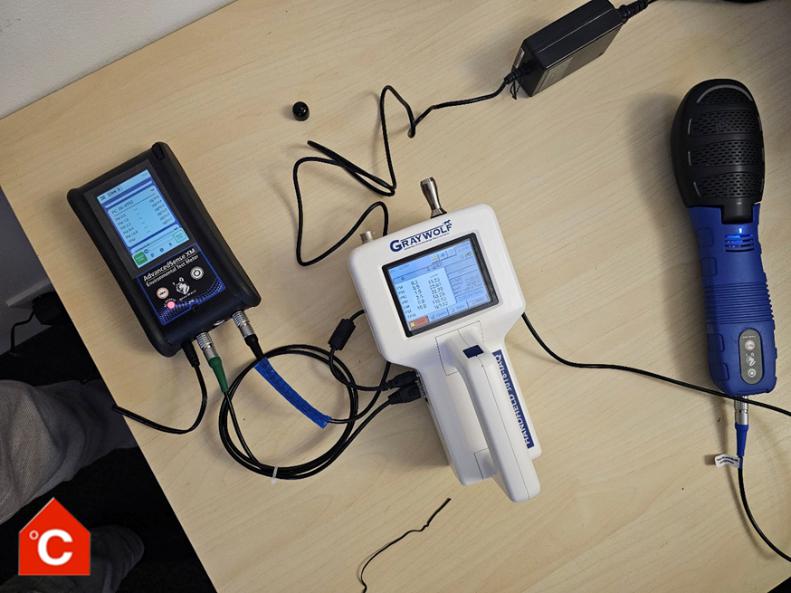
- all readings were taken with the same GrayWolf DSII-8 instrument,
- the same room was monitored under similar timing and use conditions,
- scenario 1: the air freshener discharged approximately every 40 minutes,
- scenario 2: the air freshener was removed.
This was a practical comparison rather than a controlled laboratory study. Other sources, ventilation, occupancy and sensor characteristics may also influence the recorded signal.
Measurement results
1. Measurements with the air freshener
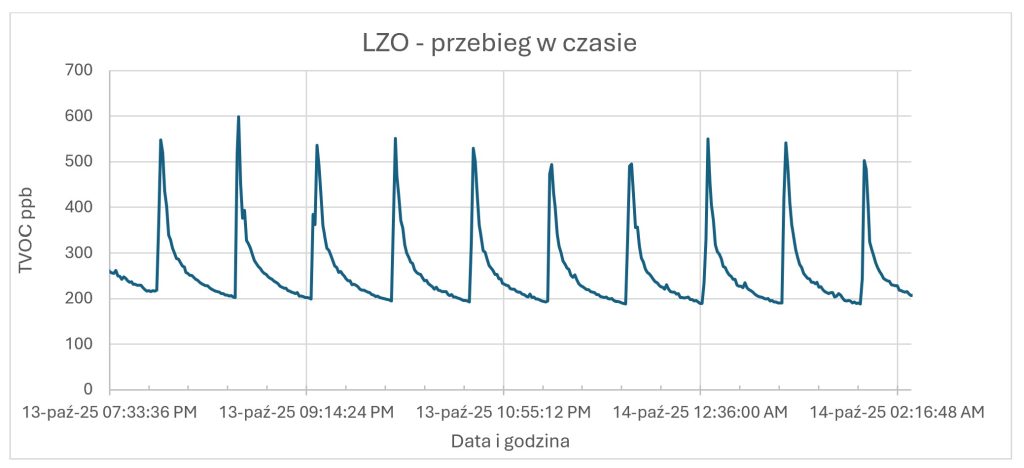
The first chart, covering 13–14 October, shows:
- repeated TVOC peaks at intervals of approximately 40 minutes,
- peak readings of approximately 500–550 ppb,
- readings of approximately 180–220 ppb after the signal declined,
- a cyclic pattern consistent with the programmed aerosol releases observed during the test.
Interpretation: the timing of the repeated peaks corresponds closely to the air freshener’s operating interval. Within the limits of this comparison, the air freshener is the most plausible source of the recorded cyclic increases.
Time between releases
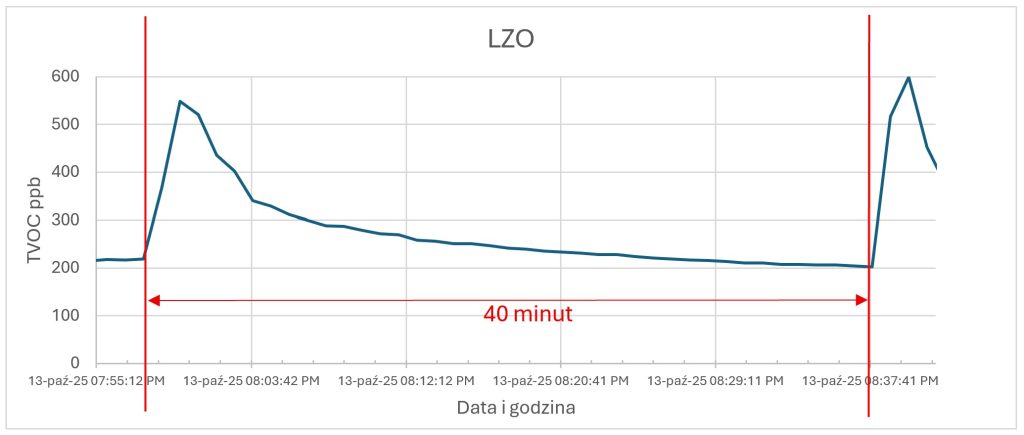
Duration of a recorded peak
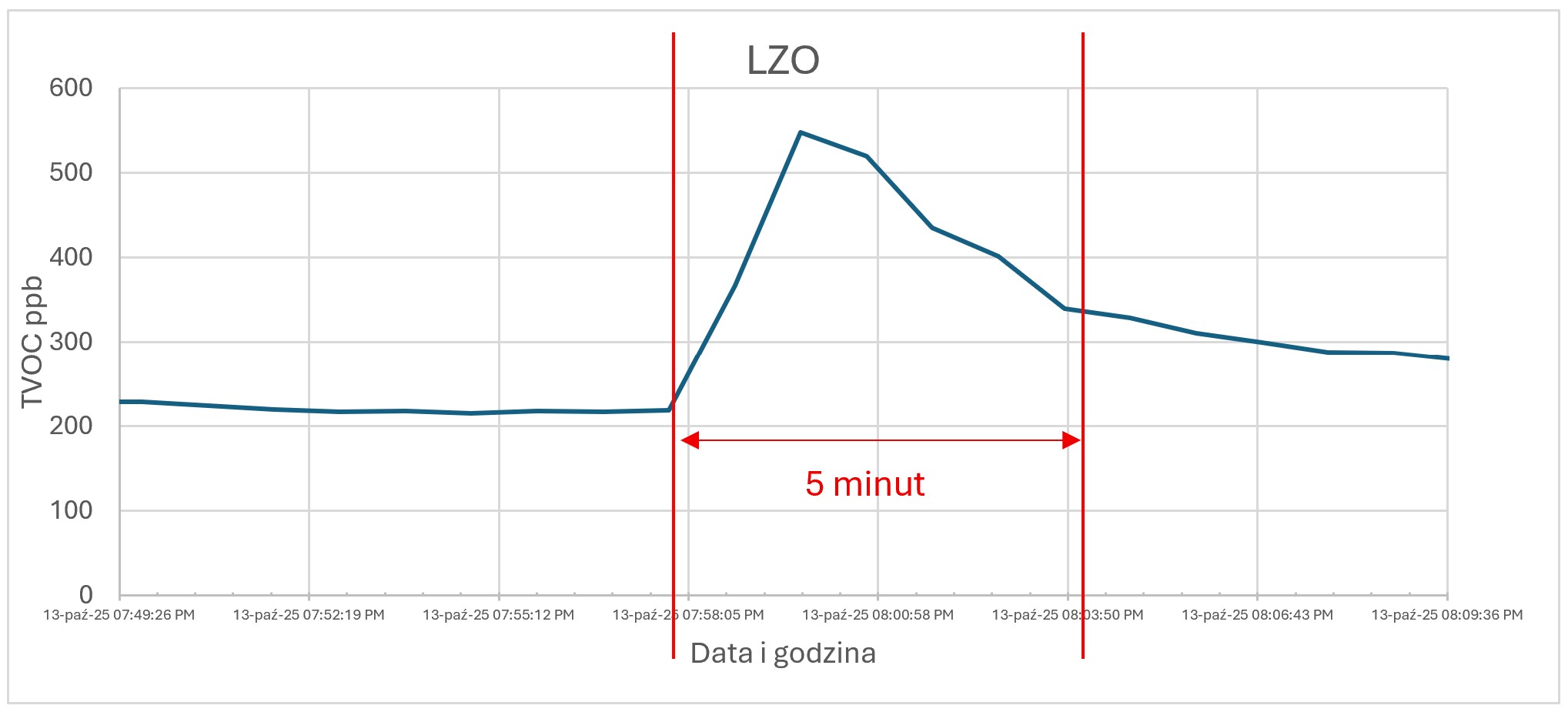
In this dataset, an individual air-freshener peak lasted approximately five minutes from the rapid rise until the reading returned towards its previous level. The interval from the beginning of one peak to the next was 40 minutes.
2. Measurements after removing the air freshener
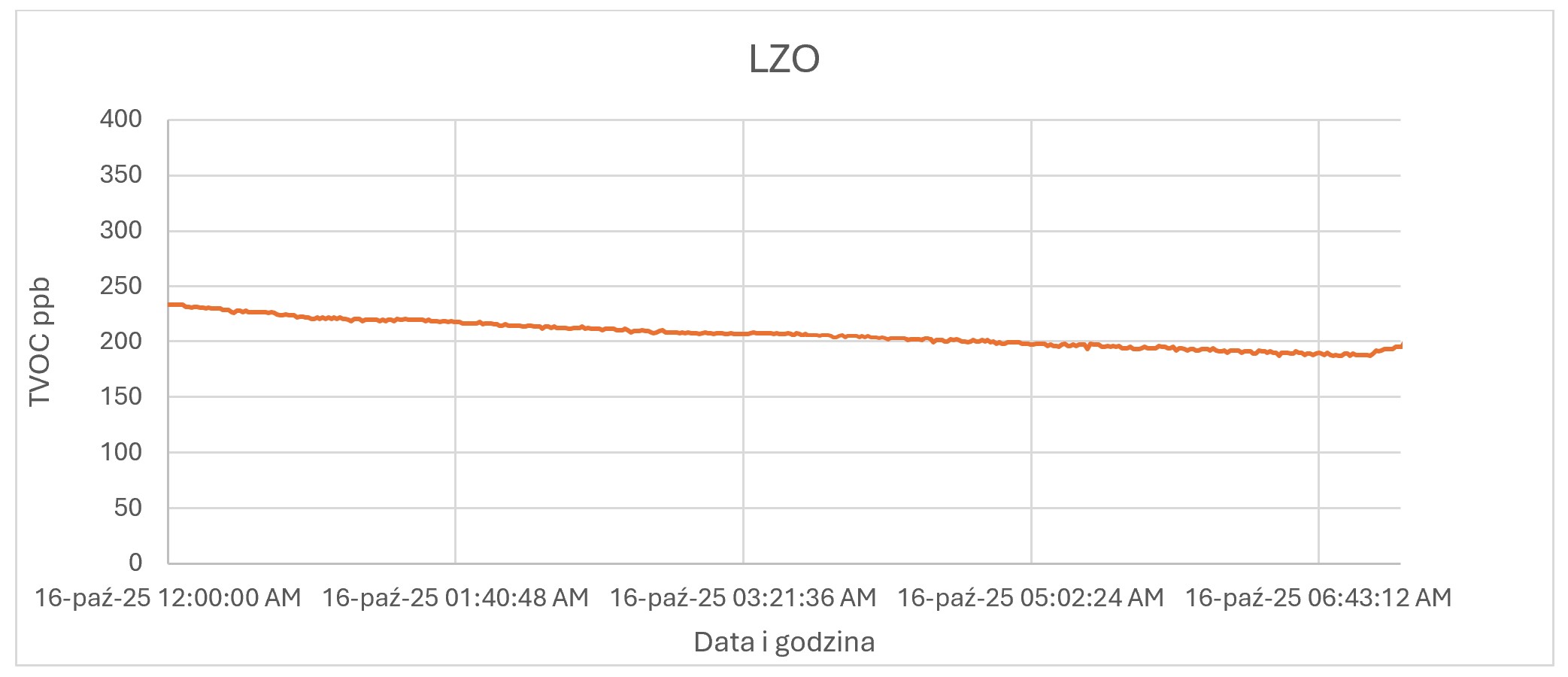
The chart from 16 October shows:
- a relatively stable trace,
- small variations of approximately 180–230 ppb,
- no rapid peaks comparable with the earlier cycle,
- a gradual decline during the recorded period.
Interpretation: after the air freshener was removed, the cyclic peaks were no longer present. The remaining variations cannot be assigned to a particular source without additional measurements and control of factors such as occupancy and ventilation.
Comparing the two scenarios
The clearest difference was the repeated TVOC response while the air freshener was operating. Many fragranced aerosol products contain volatile ingredients and solvents that can increase the reading of a broad-response VOC sensor. The exact substances and their concentrations depend on the product formulation and cannot be identified from the TVOC signal alone.
Hairspray test
Two distinct TVOC peaks were recorded when hairspray was released into the air. The instantaneous readings reached tens of thousands of ppb on the instrument, substantially higher than in the air-freshener cycle and the background period.
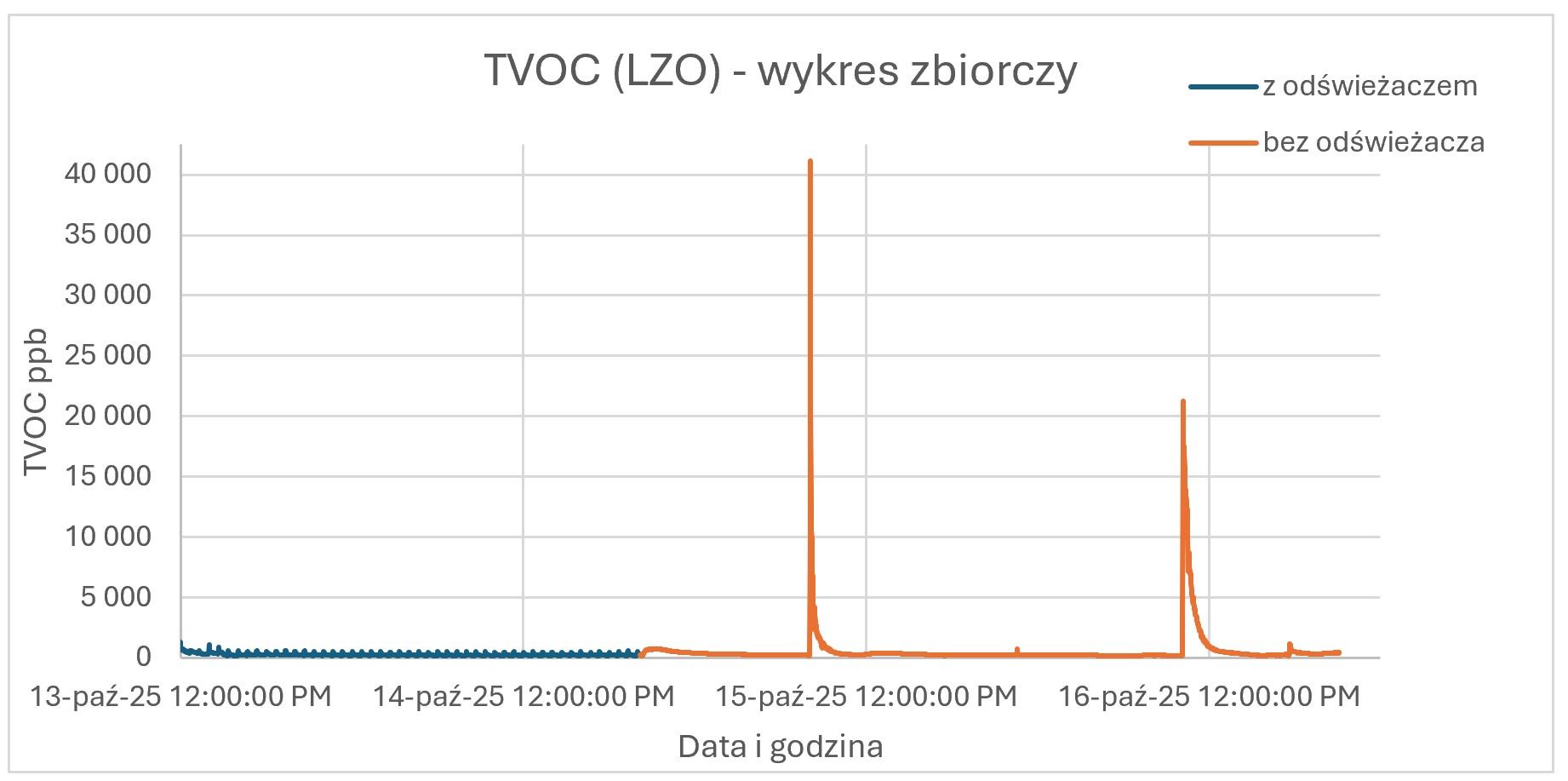
The response was brief but pronounced. In this test, the time from the rise to a return towards the previous level was approximately 10–15 minutes.
Because the experiment used a broad TVOC indicator, the recorded ppb values should be interpreted as the response of this instrument to the tested product and conditions. They are not a compound-specific exposure concentration and should not be compared directly with occupational or health limits for an individual substance.
When using aerosols, follow the product label and ventilate the room safely. Avoid spraying close to children, people with asthma or others who may be sensitive to fragrances and aerosols.
What does a TVOC reading tell us?
Household and cosmetic products — including air fresheners, hairsprays, deodorants, spray cleaners and fragranced aerosols — can release mixtures of volatile substances during use.
A TVOC measurement can reveal the timing and relative scale of such events. It cannot determine the toxicity of the mixture. Different VOCs vary widely in their health effects, and the sensor response and units depend on the measurement technology and calibration gas.
For this reason, there is no universal ppb table that can classify every TVOC reading as “safe” or “unsafe”. A health-related assessment may require compound-specific sampling, a defined measurement method and comparison with guidance applicable to the substance and jurisdiction.
The German Committee on Indoor Air Guide Values, for example, describes TVOC as a useful initial indicator but states that it cannot by itself be used for a health assessment. This distinction is important when interpreting screening measurements.
How can aerosol exposure be reduced?
Practical measures include:
- ventilating the room safely after using sprays,
- avoiding several fragranced products at the same time,
- reducing the frequency of automatic air-freshener releases,
- choosing unscented or lower-emission products where appropriate,
- not spraying aerosols close to children or people with asthma.
Indoor air measurements by TERMOCENT
If you want to investigate air quality in a home, office or workplace, the scope can include TVOC screening, particulate matter and other environmental parameters selected for the question being assessed.
TERMOCENT provides indoor-air measurements and technical support for identifying likely sources and planning further investigation. Screening results are interpreted within the limitations of the instrument and do not replace medical advice or compound-specific laboratory analysis where either is required.
Call +48 530 105 398 or email biuro@termocent.pl