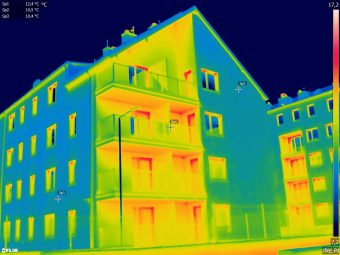
Thermal imaging is used in building diagnostics, industrial maintenance and a number of specialist fields. A thermal camera records infrared radiation emitted by a surface and converts it into a thermogram: an image showing the apparent temperature distribution. The result is useful only when the inspection conditions, camera settings and properties of the observed surface are taken into account.
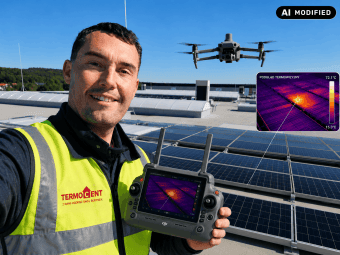
TERMOCENT carries out technical thermographic inspections and energy assessments for homes, commercial premises, offices and industrial facilities. The measurements are performed by personnel qualified in thermography, and the findings are interpreted in the context of the inspected building, installation or equipment.
What does thermographic diagnostics involve?
Thermography is a non-contact measurement method. It can reveal temperature patterns that may indicate heat loss, thermal bridges, air leakage, moisture-related anomalies, uneven operation of heating systems or abnormal heating of electrical and mechanical components. A thermogram does not identify the cause by itself. It provides evidence that must be assessed alongside operating conditions, construction details and, where necessary, other measurements.
In buildings, thermal imaging helps locate areas that require closer inspection before insulation, sealing or repair work is planned. In industry, it can support condition monitoring by identifying components whose temperature differs from comparable elements or from their expected operating pattern. Whether an anomaly is significant depends on the equipment, load, environment and inspection procedure.
Thermal imaging in buildings and commercial facilities
A building inspection can help identify discontinuities in thermal insulation, thermal bridges and areas around windows or doors where the surface-temperature pattern is unusual. The best results require suitable weather conditions and a sufficient temperature difference between the interior and exterior. Findings should therefore be treated as part of a technical assessment, not as a stand-alone diagnosis of the building.
Thermal imaging may also support an energy audit by helping the assessor decide where further checks are needed. The inspection itself does not calculate energy savings or determine the economic return from planned improvements. Those conclusions require additional building and cost data.
Thermal imaging in industrial maintenance
In production plants and warehouses, thermography can be used to inspect electrical connections, switchgear, bearings, drive systems, heating installations and process equipment. It is particularly useful when comparable components can be observed under a known load. A temperature difference can point to a developing issue, but the maintenance decision should be based on the equipment documentation, safe working procedures and other diagnostic information.
Where operating conditions permit, periodic inspections create a reference for tracking changes over time. This makes it easier to prioritise further measurements or maintenance work without assuming that every warmer or cooler area is a defect.
Thermal imaging and airtightness testing
A thermal camera can help locate air-leakage paths, especially when it is used during an airtightness test. The camera does not perform the airtightness test or determine the air-change rate. Those results come from pressure-testing equipment; thermography provides complementary visual evidence that can help find the leakage points.
What about medical thermography?
Medical thermography is a separate clinical field and is outside the scope of TERMOCENT’s technical building and industrial services. A thermal image may show surface-temperature patterns, but it cannot by itself diagnose inflammation, cancer, circulatory disease or another medical condition. In clinical use, the device, procedure and interpretation must comply with the applicable medical requirements and be handled by appropriately qualified healthcare professionals.
Thermography must not replace established medical examinations or clinical decision-making. Anyone seeking medical advice or diagnosis should contact a healthcare professional. Claims that a thermogram alone can detect disease before symptoms, determine a cause of illness or establish the time of death have therefore not been carried over from the Polish source article.
How TERMOCENT approaches technical thermographic inspections
The purpose of a technical inspection is to document relevant temperature patterns and explain what can—and cannot—be concluded from them. Before a measurement, we establish the scope, operating conditions and expected outcome. After the inspection, the thermograms are assessed together with contextual information about the building or equipment.
If you want to check a building, installation or item of industrial equipment, contact TERMOCENT to discuss the appropriate inspection method.
Call a specialist: +48 530 105 398