Professional illuminance measurements help determine whether lighting conditions meet the requirements applicable to a particular space and visual task. The assessment should be based on defined criteria rather than visual impression alone.
Why is illuminance measured?
Illuminance is measured to assess whether a space provides the quantity and quality of light required for its intended use. Measurements at workstations are especially important where visual accuracy affects task performance and working conditions.
A properly planned survey determines how much light reaches the relevant surface. Measurements can be used when commissioning a new lighting installation, during periodic reviews, after a lighting upgrade or when the use of a room changes.
Employers must provide working conditions that meet applicable occupational health and safety requirements. Lighting is one element of those conditions, but the legal basis and assessment criteria must be identified for the particular workplace.
Illuminance measurement and PN-EN 12464-1
For indoor workplaces, an important reference is PN-EN 12464-1:2022-01, “Light and lighting — Lighting of work places — Part 1: Indoor work places”, which implements EN 12464-1:2021.
The standard addresses both the quantity and quality of lighting for indoor work areas and typical visual tasks. The assessment can include maintained illuminance, uniformity, glare control and colour-rendering requirements relevant to the space.
The standard itself does not replace national occupational health and safety legislation, nor does it cover outdoor workplaces or emergency lighting. The complete assessment therefore needs to identify the room, task, measurement plane, applicable legal requirements and the correct reference criteria.
Principles of an illuminance survey
For results to be representative, the survey must follow a defined method. A measurement grid is established for the relevant area. Its arrangement depends on the size and purpose of the space and the layout of the workstations.
The measurement height also matters. For a workstation, readings are normally taken on the relevant working plane — the surface on which the visual task is performed.
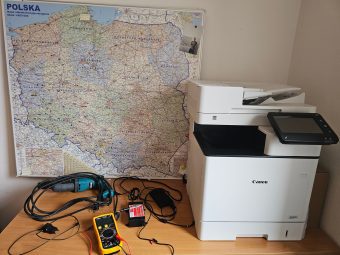
The survey should use a suitable lux meter with valid calibration information and should record the operating condition of the lighting, daylight conditions where relevant, the measurement grid and the reference criteria. These details allow the results to be interpreted and repeated.
Illuminance measurements by TERMOCENT
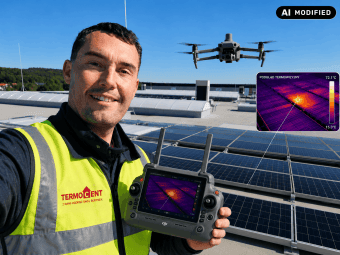
TERMOCENT performs lux-meter measurements for indoor spaces and work areas across Poland. We select the measurement method and reference criteria for the intended use of the room and document the results in a clear report.
The report can support the commissioning or review of a lighting installation and help identify areas that require adjustment or further design work. It does not replace a project-specific legal or design assessment where one is required.
Speak to a specialist: +48 530 105 398
or email biuro@termocent.pl