As environmental considerations become more important in property management and sustainable-building assessment, reducing unnecessary night-time light is receiving greater attention. In BREEAM In-Use International Commercial V6, the subject appears under POL 06, “Reduction of night time pollution”. The exact criteria depend on the scheme, version, asset type and assessment route used for the project.
TERMOCENT prepares light-pollution strategies supported by site measurements and technical reporting for use as evidence in a BREEAM In-Use assessment.
What is light pollution?
Light pollution is excessive or poorly directed artificial light emitted into the night-time environment. It can contribute to:
- disturbance of human circadian rhythms,
- disruption to fauna and flora,
- nuisance for occupants of neighbouring properties,
- unnecessary energy consumption,
- sky glow above built-up areas.
In a BREEAM context, external lighting should be designed and operated to limit its effect on the surroundings while maintaining the safety and functionality required for the asset.


What can a POL 06 analysis include?
The TERMOCENT service can include the following activities, selected against the requirements of the BREEAM In-Use scheme and version applicable to the asset:
- Review against the relevant POL 06 requirements
We review the external-lighting installation and the project evidence against the night-time light-pollution criteria applicable to the assessment. - Illuminance and upward-light measurements
Measurements can include:- illuminance (lx),
- parameters used to assess light emitted into the upper hemisphere, including the Upward Light Ratio (ULR), where applicable.
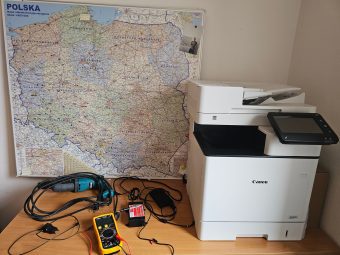
We use an LP 471 PHOT photometric probe for illuminance measurements. The probe’s spectral response is designed for photometric measurement; the complete method and measurement uncertainty must be matched to the assessment requirement.

- Assessment of external light sources and their surroundings
We identify relevant sources — such as façade and car-park luminaires, architectural illumination and illuminated advertising structures — and consider their effect on:- neighbouring sites,
- residential areas,
- public roads,
- the natural environment.
- Comparison with the applicable guidance
The measured and documented conditions are compared with the requirements for the environmental zone and assessment route concerned. We identify potential non-conformities and prepare evidence for review by the project’s licensed BREEAM Assessor. The final award of credits remains the assessor’s decision.

Preparing a light-pollution reduction strategy
Based on the review, the strategy may consider measures such as:
- changing the luminaire type, for example to fittings that limit upward light,
- introducing controls such as photocells, astronomical time switches or reduced output at night,
- optimising the direction and angle of the luminaires,
- limiting decorative illumination during specified hours,
- replacing light sources with more energy-efficient alternatives where technically justified.
The strategy provides the asset manager with a practical plan for the assessment and for improving the operation of the external-lighting system. The actual energy and cost effects depend on the existing installation and the measures implemented.

POL 06 report for a BREEAM In-Use assessment
The report can include:
- a description of the scope,
- the measurement method,
- illuminance results,
- an assessment of upward light,
- photographic documentation,
- a comparison with the applicable POL 06 requirements,
- recommended corrective measures, where required.
The document is prepared for use as technical evidence in the BREEAM In-Use assessment. Its final acceptability and the award of credits are determined within the formal assessment process.
Why address night-time light pollution?
Measures developed for POL 06 can also support:
- more responsible environmental management of the asset,
- reduced unnecessary electricity use,
- lower operating costs where consumption is reduced,
- better control of nuisance affecting users and neighbours,
- alignment with recognised sustainable-building practice.
TERMOCENT can support the process from site measurements and technical analysis to the preparation of the assessment documentation.
If you are planning a BREEAM In-Use assessment or reviewing the external lighting of an existing asset, contact our team to define the appropriate scope.
Call +48 530 105 398 or email biuro@termocent.pl